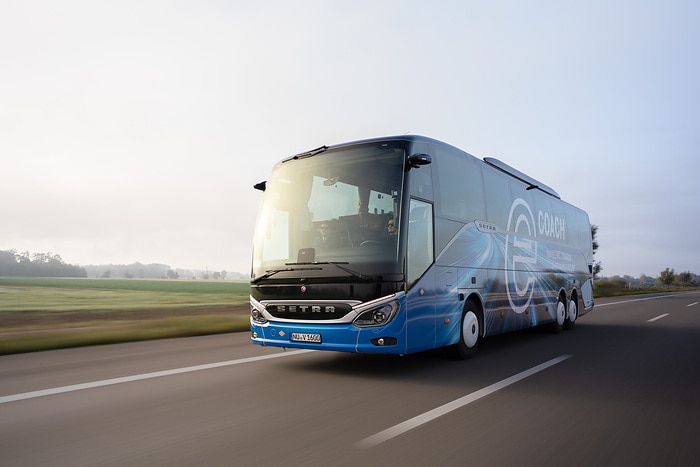
Daimler Buses and its partners have driven the ELCH battery-electric coach technology demonstrator in Neu-Ulm, Germany. The early-October 2026 outing marks a development milestone, while the project’s range of more than 500 kilometres remains a design target rather than a published test result.
Featured photograph: © Daimler Truck AG. Source: Daimler Buses newsroom, 14 October 2026.
A joint drive, not a commercial launch
At their final in-person consortium meeting in Neu-Ulm in early October, the partners in the Electrified Coach (ELCH) research programme took a joint drive in the project’s technology demonstrator. Daimler Buses announced the milestone on 14 October 2026. The manufacturer described the drive as an opportunity to test and validate technical concepts under practical conditions, with the programme continuing until the end of 2026.
The exact day of the drive was not identified in the announcement. Daimler did not publish a measured distance or verified single-charge range from this outing. The more-than-500-kilometre figure describes the range for which the demonstrator is designed; it is not a reported distance achieved in Neu-Ulm.
Engineering for long-distance operation
ELCH brings together vehicle engineering, operational data and economic analysis. Daimler Buses coordinates the programme. Karlsruhe Institute of Technology (KIT/ITIV) works on vehicle-data analysis and operating strategies, while researchers at RPTU Kaiserslautern-Landau examine lightweight construction and aerodynamics. The University of Mannheim’s MISES team assesses economic viability across different operating profiles.
Flix contributes operational and deployment data from long-distance coach services, helping the partners develop representative driving cycles. Its involvement is particularly relevant to assessing an electric coach against the realities of scheduled intercity operations rather than treating range as an isolated specification.
The collaboration was announced in 2022 with plans for a modular electric drivetrain and two demonstration vehicles. The October 2026 announcement documents the joint drive of a technology demonstrator; it does not establish that both originally planned vehicles have completed testing.
What operators still need to know
For coach operators, the key question is not simply whether a demonstrator can reach a headline range target, but whether a future production vehicle can reliably cover scheduled routes with charging stops, turnaround times and available infrastructure taken into account. The Neu-Ulm drive does not yet answer that operational question.
Daimler’s 14 October announcement did not provide a measured single-charge range from the drive or specify the demonstrator’s battery capacity, charging power or vehicle weight. Published performance data and fuller technical specifications would be needed to assess its suitability for particular routes.
What follows the ELCH demonstration
The research programme is backed by €6.26 million in German federal funding and is scheduled to conclude at the end of 2026. Its results are intended to inform Daimler Buses’ development of future battery-electric coaches. The manufacturer’s broader ambition is to offer battery-electric coaches by the end of the decade.
The Neu-Ulm drive is therefore a step in technology validation, not the introduction of a series-production coach or proof of a 500-kilometre road-test result.
Sources
Daimler Buses, 14 October 2026; Daimler Buses, project launch; Flix; KIT ITIV.
Related EBGJ coverage: Germany’s 2027 E-Bus Funding Cut (a separate funding issue).