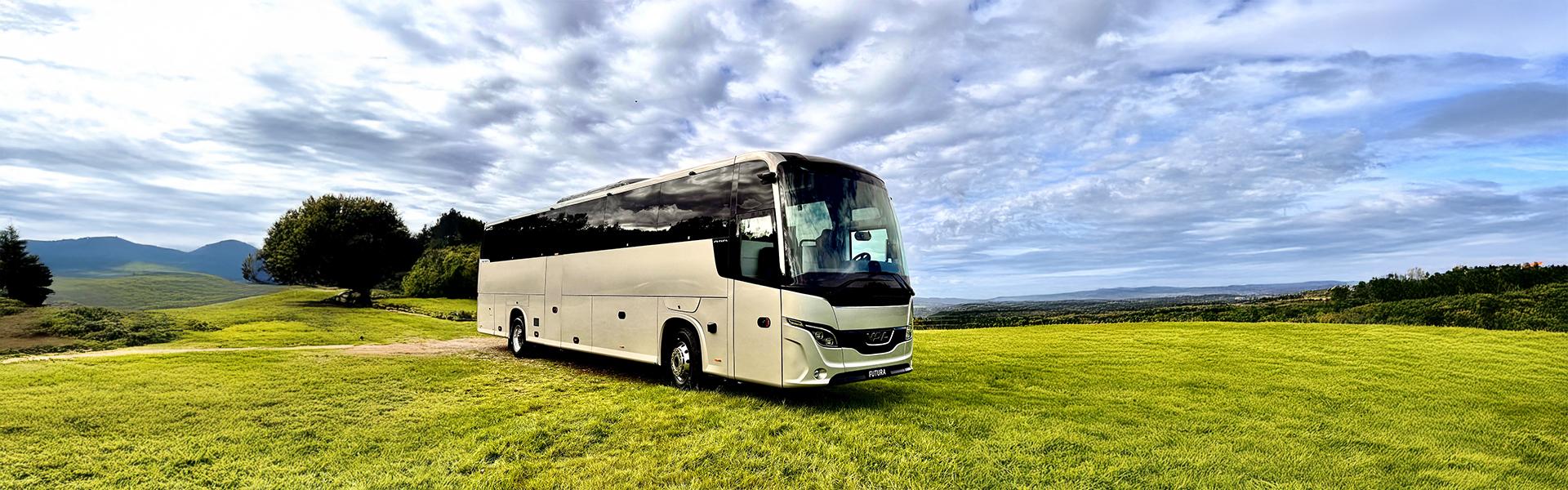
Lead photograph: exterior view from the VDL Futura 3 product presentation. Photo: VDL Bus & Coach.
The third-generation VDL Futura made its public debut at Busworld Europe 2025 with a redesigned front and a visibly convex windscreen. The change is noteworthy in its own right: the windscreen forms part of the vehicle’s aerodynamic redesign, as explicitly described in Busworld’s launch coverage.
A genuinely new front-end design
The report described VDL Futura 3 as the third generation of the coach and linked its debut to the consolidation of VDL Bus & Coach and VDL Van Hool in the VDL Bus Group. The change at the front was not merely a new badge: the source identified the convex windscreen as a notable feature compared with the earlier Futura.
The design had been previewed as a mock-up at Busworld 2023. At the 2025 launch, the Futura 3 also received Busworld’s Coach Design Award. Busworld reported VDL’s claim that the combination of redesigned aerodynamics and driveline could reduce fuel consumption by 15%; this is a manufacturer projection, not an independently verified fleet result. Source: Busworld Europe, 5 October 2025.
Why the convex windscreen matters
A convex windscreen is not a purely decorative styling element. Its outline, curvature, optical characteristics and attachment geometry are relevant to replacement, but the public VDL presentation provides no dimensional drawing or approved parts cross-reference. An older Futura windscreen must therefore not be presumed to fit the third generation.
Aerodynamics and serviceability are connected
Curved glazing can contribute to an aerodynamic shape and an integrated exterior appearance. It can also place more demanding requirements on replacement logistics: a large shaped panel has to be transported without point loading, stored securely and installed without compromising the bonding system. Those are practical considerations, not claims that the Futura 3 uses any particular adhesive or packaging method.
From launch announcement to spare-part reference
For the Futura 3, the key information still to obtain is the original windscreen reference for each applicable body variant, approved replacements and handling instructions for the new curved component. Such data should come from VDL or a verified technical catalogue, not dimensions estimated from show photographs. The Journal’s identification guide covers the routine intake process separately.
The broader takeaway
VDL Futura 3 is one of the clearer recent examples where the vehicle maker’s published description specifically identifies a change to a large glazed component. The confirmed development is the new convex windscreen; its exact spare-part references and fitment restrictions remain a separate technical question.
Sources
Related reading: Scania Touring: another generation-specific glazing identification checkpoint.